How dry ice cleaning works — and why it's safer.
The complete guide. Four cleaning forces, safety science, a full application directory and the limits — so you can make an informed decision before you call anyone.
Four forces. One blast. Zero residue.
Dry ice cleaning works because pellets of solid CO₂ exploit four simultaneous physical effects when they hit a contaminated surface. None of them are abrasion.
1. Embrittlement
Organic materials harden and embrittle under cooling. At −78.5°C, the contaminant loses its elasticity and adhesiveness, making removal dramatically easier. Think of frozen chewing gum — it cracks right off.
2. Thermoshock
The sudden local cooling creates intense differences in shrinkage rates between the contamination layer and the substrate. These thermal tensions fracture the bond and loosen the compound — without touching the substrate itself.
3. Kinetic Impact
Pellets accelerated to near-sonic speed (via a Laval nozzle) deliver kinetic energy on impact. This force is converted into an abrasive-like cleaning action — except the pellet is softer than plaster and sublimated before any damage occurs.
4. Explosive Sublimation
The heat transfer from the warm surface causes the solid CO₂ to sublimate instantly to gas — a volume expansion of approximately 800×. This micro-explosion blasts the already-loosened contaminant clear, carried away on the flow of compressed air.
What are dry ice pellets?
Dry ice is the solid form of carbon dioxide (CO₂). When energy is applied — whether heat or impact — it converts directly from solid to gas without ever becoming liquid. This process is called sublimation, and it's what makes the cleaning agent disappear after every blast.
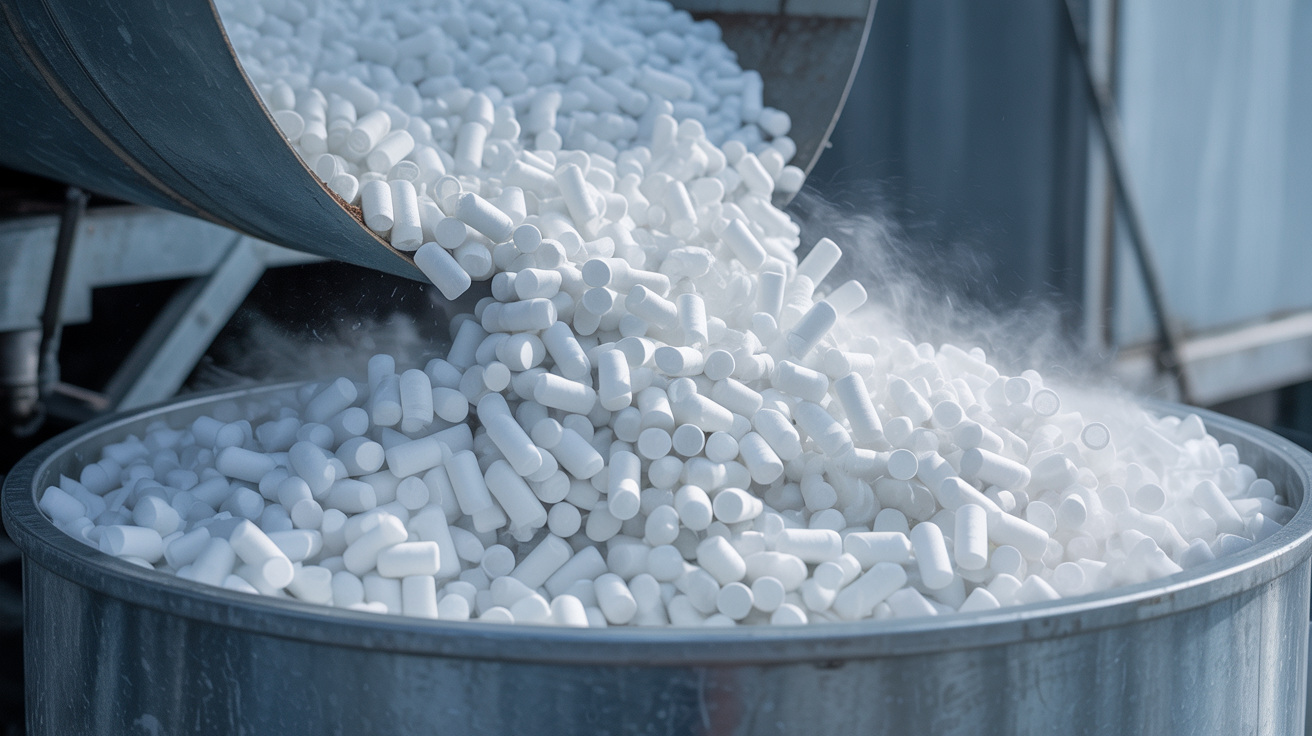
Pellets are produced by pressing cryogenic CO₂ snow through special dies. They have a characteristic rice-grain shape and last 5–7 days in insulated containers.
Pellet specifications
- Temperature−78.5°C
- HardnessSame as plaster (Mohs ≈1.5)
- Pellet size3 mm wide × 5–10 mm long
- Bulk density~1,000 kg/m³
- Contains waterNo — completely dry
- Liquid phaseNone — solid to gas directly
- ToxicNo — CO₂ is non-toxic
- FlammableNo — CO₂ is non-flammable
What a job actually looks like.
Free on-site assessment
We walk the site, identify hazards, scope the contaminants and confirm access.
Tailored safety plan
JSA, SWMS, PPE, ventilation and isolation procedures issued before we start.
Dry ice blast clean
Recycled CO₂ pellets accelerated by compressed air strip the surface — no water, no residue.
Verify & hand back
Photo report, sign-off and same-day return to service. We leave the site cleaner than we found it.
The real risks — and how we manage them.
Dry ice cleaning eliminates chemical and slip hazards, but introduces CO₂ build-up, extreme cold, noise and electrostatic charge. All managed by process.
Full safety & compliance pageCO₂ monitoring
Real-time multi-gas detector. Alarm at 3,000 ppm (well below the 5,000 ppm TLV). Forced ventilation always on standby.
Noise & hearing
100–130 dB(A) at the nozzle. Class-5 hearing protection, silenced applicators, 5m exclusion zone.
Cold burns
−78.5°C requires cryogenic gloves, face shields and full PPE. Zero bare-skin handling at any stage.
Electrostatic
CO₂ is prone to static charging. All equipment grounded. Explosion-risk areas suspended via ventilation + monitoring.
Dry ice vs the rest of the industry.
| Method | Water use | Residue | Downtime | Risk profile | Substrate-friendly? |
|---|---|---|---|---|---|
| Pressure water | High | Wet sludge | Hours–days | Slip / electrical | Substrate-dependent |
| Chemical scrubbing | Low–medium | Solvents + waste | Hours | Inhalation / skin | Material-dependent |
| Sand / soda blasting | None | Spent media + dust | Hours | Abrasion / silicosis | Hard substrates only |
| Manual scraping | None | Minimal | Many hours | Repetitive strain | Labour-intensive |
| Dry ice (Dry Carbon Clean) | None | Just the contaminant | Minimal | CO₂ + noise (managed) | Almost any substrate |
Where dry ice cleaning is used across industries.
From food production to power generation, this directory covers the most common applications. The success depends on your specific process, contamination type and substrate.
Food & Beverage
- Bread & pastry machines
- Chocolate equipment
- Fat-processing lines
- Ovens & conveyor belts
- Deep cleaning in industrial kitchens
- Packaging & labelling machines
- Fish & cheese processing
- Cold storage equipment
Printing & Packaging
- Offset printing presses
- Conveyor belts
- Crown-cork production
- Die plates & punching tools
- Finishing & labelling machines
- Paper mill filter screens
- Toner extruder screws
- Flexographic rollers
Automotive & Manufacturing
- Injection & blow moulds
- Compression moulds
- Paint & E-coat booths
- Weld line robots
- Foundry core boxes & dies
- CNC machine surrounds
- Rolling mill rollers
- PVD machines
Rubber, Plastics & Foam
- Polyurethane moulds
- Vulcanisation moulds
- Tyre moulds
- Conveyor belts
- Splitter rollers
- Tunnel driers
- Production machinery
- Packaging materials
Restoration & Cleaning
- Car & machinery restoration
- Railway platforms & escalators
- Public spaces & gardens
- Parquet & hardwood floors
- Boats & yachts
- Building facades
- Aluminium windows & doors
- Building decontamination
Industrial & Power
- Turbine blades
- High-voltage installations
- Flues & ventilation ducts
- Heat exchangers
- Storage tanks
- Welding robots
- Switchboxes
- Electric generators
Six things people get wrong about dry ice.
Myth
It's just sandblasting with ice
Reality
Dry ice pellets are 9× softer than baking soda and never abrade the substrate — the cleaning is thermal and kinetic, not abrasive. The pellet disappears on contact.
Myth
CO₂ means greenhouse gas pollution
Reality
We use recycled CO₂, captured as a by-product from existing industrial processes (ammonia synthesis, fermentation). This CO₂ would have been released anyway — we borrow it for cleaning first.
Myth
It's only for industrial use
Reality
Same physics, smaller machine. Engine bays, fireplaces, timber beams, facades and BBQs all benefit from the same gentle method.
Myth
You can't use it on live electrics
Reality
Because there's no water and no residue, dry ice is one of the safer options for live switchgear, motors and PLCs. It's non-conductive.
Myth
It's too expensive
Reality
Per square metre, maybe. Per job — factoring downtime, dismantling, waste-water fees and equipment damage — it's usually significantly cheaper.
Myth
The CO₂ is dangerous
Reality
CO₂ displaces air in poorly ventilated spaces — that's the risk. With real-time gas monitoring, forced ventilation and proper safety protocols, it's fully managed.
Get the Equipment Cleaning Planner
What to clean, what NOT to clean, shutdown optimisation tips and a risk reduction checklist.
Everything else you might want to know.
Follow along — from assessment to completion.
We document every job from the initial site walk-through to the final result. Follow us on social media for real-world proof of what non-toxic, non-flammable CO₂ cleaning looks like across dozens of industries.
Read enough? Let's look at your job.
A free site assessment costs nothing and answers questions an article can't.